
DMart Expects Higher June Quarter Profit Amid Quick-Commerce Pressure
Authored by lion-bet.net, 09 Jul 2026
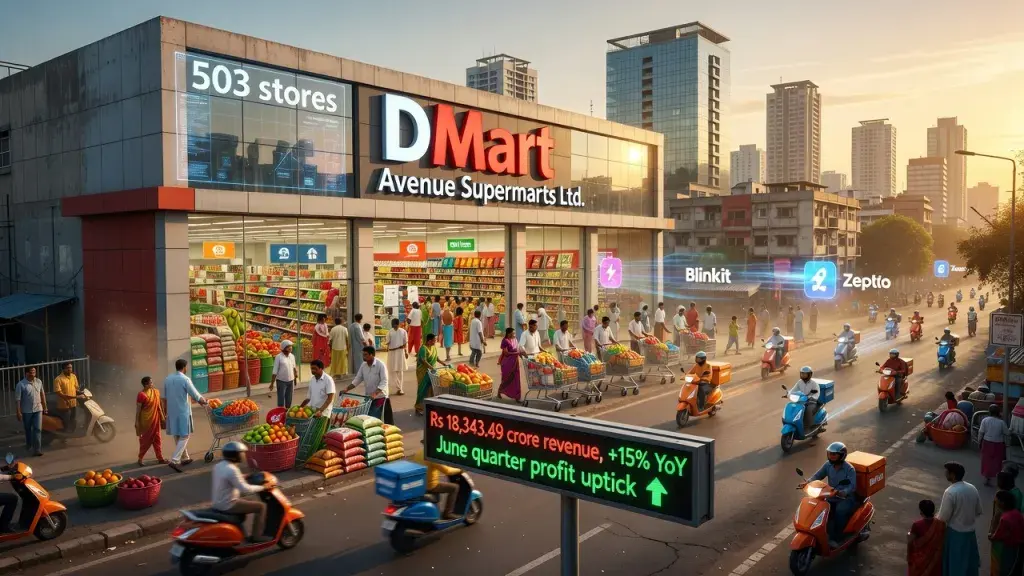
Avenue Supermarts Ltd., the parent company of India's DMart supermarket chain, is set to report improved profitability for the quarter ended June 30, with standalone revenue from operations reaching Rs 18,343.49 crore - a 15% increase year-on-year, according to a business update disclosed to stock exchanges on July 2. The headline number offers a degree of reassurance, but the full quarterly results will be scrutinised closely by investors weighing whether genuine business momentum is taking hold or whether the structural threat posed by quick-commerce platforms is still eroding DMart's competitive moat.
The reported revenue figure remains subject to a limited review by the company's statutory auditors, which means the final certified numbers could carry minor adjustments. Still, the scale of the growth signals that consumer footfall and basket sizes held up reasonably well across the quarter. For those tracking the broader consumer discretionary landscape in India - including analysts at outlets such as SapphireBet media who cover how large-scale retail and entertainment economies interact - the story of DMart is emblematic of how traditional brick-and-mortar businesses are navigating a rapidly digitising market.
Brokerages Divided as Same-Store Sales Picture Remains Unclear
The most telling debate in the analyst community centres not on total revenue growth, but on same-store sales growth - the metric that best captures whether existing stores are performing better or simply being propped up by new openings. Bank of America offered a cautiously optimistic read, suggesting that underlying same-store sales growth may have bottomed out and that the core retail operation appears to be stabilising. However, the bank was careful not to overstate its case, noting it was too early to conclude that competitive pressures from quick-commerce players had meaningfully eased.
Citi took a more sceptical stance, pointing to ongoing valuation concerns and flagging that risks to both same-store sales growth and earnings remain elevated given the pace at which rapid-delivery platforms have expanded their urban footprint in India. Macquarie was the most pointed in its assessment, saying that both sales growth and store additions fell short of its expectations, and that same-store sales growth had actually moderated compared to the previous quarter. Taken together, the brokerage opinions paint a divided picture: some green shoots, but no clear all-clear signal.
503 Stores and the Ongoing Expansion Question
DMart ended the June quarter with a total of 503 stores, as confirmed in its first-quarter business update. Store count growth is one of Avenue Supermarts' traditional levers for revenue expansion, but the quality of that expansion - specifically, whether new stores are reaching productivity benchmarks quickly enough - is increasingly a focal point for investors. If store productivity remains subdued and same-store sales growth continues to lag, new openings alone will not be sufficient to sustain the kind of earnings trajectory the market has historically priced into the stock.
The quick-commerce threat is not hypothetical. Platforms offering ten-to-thirty minute grocery delivery have gained significant traction in India's tier-one cities, precisely the urban, high-density markets where DMart has typically enjoyed strong throughput. The company's model - large-format stores, high volumes, thin margins passed on to consumers as low prices - is structurally different from the convenience-first proposition of quick-commerce apps, and that distinction will define how the competitive dynamic evolves over the coming quarters. Full quarterly results, when auditor-reviewed, will provide the clearest picture yet of whether DMart is finding an answer.