
Ronaldo Chases the One Title That Has Always Eluded Him
Authored by lion-bet.net, 18 Jun 2026
As the 2026 Fifa World Cup unfolds across North America, the football world is consumed by a question that refuses to go away: does Cristiano Ronaldo need to lift the trophy on July 19 to be considered among the greatest players the game has ever produced? At 41 years old, the Portuguese forward is almost certainly playing in his final World Cup, and the stakes - personal, historical, and emotional - could not be higher.
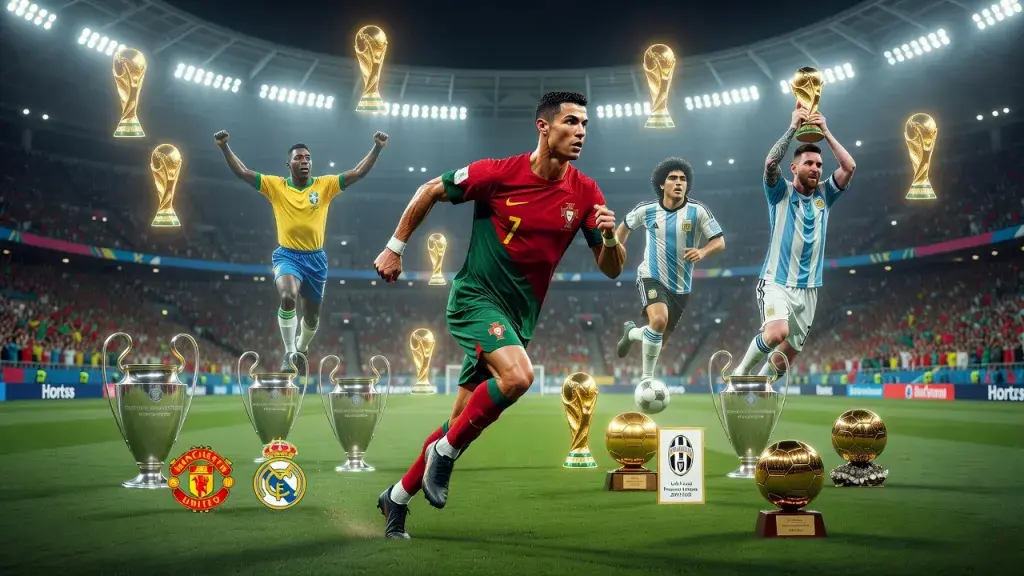
The debate itself is as old as the tournament, and it divides fans and pundits with the same ferocity it always has. Traditionalists hold firm: to stand alongside Pelé, Diego Maradona, and Lionel Messi in football's most exclusive conversation, you must have a World Cup winner's medal. It is worth noting that this kind of singular, high-stakes pursuit grips fans of multiple sports simultaneously - much like how enthusiasts follow niche competitions through tools such as the racing post greyhound bet app to track every result in real time - but in football, no platform or metric fully captures what a World Cup means to a nation and its players. For Ronaldo, that meaning is enormous.
The Messi parallel is impossible to ignore. For the better part of two decades, Argentina's talisman endured precisely the same criticism - brilliant beyond measure at club level, allegedly incomplete without the World Cup. Qatar 2022 closed that chapter. Now the same narrative surrounds Ronaldo, and he has one final opportunity to write his own ending.
A Career That Needs No Asterisk
The case for Ronaldo's greatness without a World Cup title is overwhelming, and it deserves to be made plainly. He is the highest goalscorer in the history of professional football. He has won five Uefa Champions League titles - a competition that demands sustained excellence across eight to ten months, against the continent's elite clubs, with no margin for error. He won league titles in England with Manchester United, in Spain with Real Madrid, and in Italy with Juventus, becoming a dominant force in three of world football's most competitive environments. Five Ballon d'Or awards recognise what his peers and the sport's governing bodies have long accepted: he is one of the finest players the game has ever seen.
To suggest that achievement requires a World Cup to be validated is to misunderstand both the trophy and the man. The World Cup is a one-month tournament played every four years. A player's availability, their squad's collective strength, the draw, injuries, and refereeing decisions all shape outcomes. It is not a controlled measure of individual brilliance. Ronaldo's career has been measured across 20 years, in hundreds of matches, at the highest level of the club game - and that record is beyond dispute.
The Context Critics Choose to Ignore
There is another dimension to this debate that its most vocal participants consistently overlook: the country Ronaldo represents. Pelé played for Brazil, arguably the greatest footballing nation on earth. Maradona led Argentina, a country with deep World Cup roots and a culture built on the game. Ronaldo was born in Madeira and grew up representing Portugal - a nation that, before his era, had qualified for just one World Cup in the 28 years preceding his debut. He did not inherit a winning machine. He was central to building one.
His international record stands on its own terms. He led Portugal to their first-ever major trophy at Euro 2016, a tournament win that meant everything to a country that had been knocking on football's biggest doors for generations. He was instrumental in the 2019 Nations League triumph. He has scored more international goals than any player in football history. These are not footnotes - they are chapters of genuine significance in the story of a nation's sporting identity.
The Missing Piece and What It Would Mean
None of that erases the one glaring gap that critics will always return to: Ronaldo has never scored in a World Cup knockout match. In a tournament defined by its moments - Pelé at 17, Maradona's hand and his genius against England in 1986, Messi's exhausting, emotional journey to Lusail - that absence matters more than any spreadsheet can explain. World Cups do not just produce winners; they produce folklore. And folklore, by its nature, is not easily manufactured after the fact.
If Portugal go deep in North America and Ronaldo delivers when it matters most, the conversation changes permanently. A World Cup title would not prove something new about his ability - that has never been in genuine doubt - but it would silence a specific and persistent criticism that has followed him for two decades. Whether it would then elevate him above Messi and Pelé in the broader historical ranking is a question worth asking, and one that football fans would argue about with relish.
What is clear, heading into the tournament, is this: Cristiano Ronaldo has already built one of sport's greatest individual careers. A World Cup title in 2026 would be the final, spectacular ornament on a monument that stands regardless. Its absence does not diminish what he has already done. The game's history is richer for the debate - and so is this particular World Cup.