
World Cup Upsets Already Arriving as Three Fixtures Promise More Chaos
Authored by lion-bet.net, 18 Jun 2026
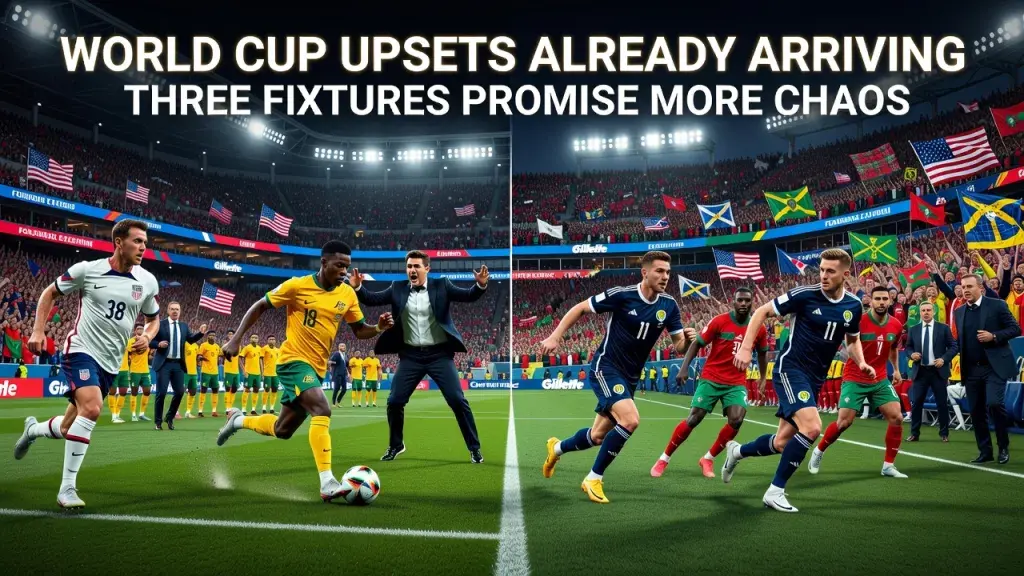
The 2026 FIFA World Cup has barely found its stride, and the script is already being torn up. Australia stunned Turkey 2-0, Cape Verde held European champions Spain to a goalless draw, and DR Congo claimed their first-ever World Cup point against Portugal - results that signal the expanded 48-team format is not merely decorating the tournament with minnows, but genuinely redistributing the power. The group stage is only beginning, and the most consequential fixtures are still ahead.
The context matters here. A larger tournament means more teams, but it does not guarantee more safety for the favourites - if anything, the desperation of sides facing early elimination sharpens their focus and compresses their tactical margins for error. It is worth noting that interest in global sports competition has surged well beyond traditional football strongholds, from basketball to combat sports to niche disciplines like फ्लोरबॉल बेटिंग, reflecting a broader appetite for competitive sport that this World Cup, with its unprecedented scale, is feeding in full. Three group-stage fixtures this week carry particular weight.
USA vs Australia - Seattle, Friday June 19
The United States opened with authority, defeating Paraguay 4-1 in Los Angeles in a display that drew widespread praise and raised expectations for Mauricio Pochettino's project. But Australia's 2-0 win over Turkey means this is not a fixture the hosts can approach with comfort. Tony Popovic's Socceroos executed a disciplined, low-block defensive structure and punished Turkey on the counter - a blueprint that has historically created problems for USA sides under multiple managers.
Nestory Irankunda was the primary outlet in behind for Australia against Turkey, and his directness will test a USA backline that includes 38-year-old Tim Ream. Pochettino's side has shown genuine attacking quality, but generating consistent chances against compact defensive shapes remains an unresolved question. Australia, listed as outsiders at 15/4, arrive in Seattle having already proved one set of doubters wrong.
Scotland vs Morocco - Foxborough, Friday June 19
Scotland marked their return to the World Cup stage with a 1-0 win over Haiti, though Steve Clarke would be the first to acknowledge it was laboured. Grinding past a side ranked 83rd in the world with little fluency does not suggest a team ready to trouble the 2022 semi-finalists. And yet the tactical dynamic shifts considerably when Scotland face a team that wants to hold the ball rather than sit back and absorb.
Morocco's possession-based approach may actually liberate John McGinn and Scott McTominay, two players who found little room to operate against Haiti's low block. Clarke's Scotland have always been more comfortable responding to pressure than creating against it, and their qualification for this tournament - sealed with a famous win over Denmark - showed they are capable of rising to a big occasion. At 4/1, few expect them to avenge their 1998 World Cup defeat to Morocco, but the match-up is more complicated than the surface odds suggest.
Netherlands vs Sweden - Houston, Saturday June 20
Sweden arrived at this tournament under a cloud of uncertainty. Graham Potter took charge only in October, the team scraped through qualification via the Nations League after finishing bottom of their group, and expectations were correspondingly low. None of that was reflected in their opener: a dominant victory over Tunisia that featured a fluid attacking partnership between Viktor Gyökeres and Alexander Isak that will concern defenders at every level of this competition.
Ronald Koeman's Netherlands have the midfield depth - Frenkie de Jong, Ryan Gravenberch and Tijjani Reijnders give them genuine control through the centre - but their defensive vulnerabilities were exposed in a 2-2 draw with Japan. If Sweden's front two find the same rhythm they showed against Tunisia, the Dutch will have a serious problem to manage. At 7/2, Potter's side remain outsiders, but they are no longer an unknown quantity. This tournament may well be the stage on which Sweden's new identity is properly introduced.